
Payment Challenges For Cross-Border E-Commerce Stores

Garry
April 6, 2026
1
minutes
.webp)

Is your e-commerce store losing money to invisible barriers you didn't even know existed? Although the internet enables any brand to reach a global audience in an instant, the financial systems beneath are still scaling. International expansion is often a double-edged sword for merchants: Most find that it brings with it a flood of technical and logistical challenges that threaten to derail growth. Understanding the most common cross-border ecommerce payment challenges is a gigantic lost opportunity if ignored.
This is especially true when itcomes to payment for independent cross-border e-commerce stores, whereowners often have to navigate these hurdles without the negotiating power ordedicated finance teams larger retailers rely on.
Industry data suggests that cross-border e-commerce will be growing at twice the rate of domestic e-commerce by 2026 with total global sales exceeding $2.1 trillion.
Cross-border payment failures and friction have long been the number one reason for cart abandonment globally - from failed transactions to hidden or unexpected fees. Winning over the international market is two steps out of thousands - you need a plan to tackle these complicated cross-border ecommerce payments problems.
Scale Your E-Commerce Business Globally Without Payment Barriers
Expanding internationally shouldn’t mean dealing with failed payments, high fees, or compliance risks. At FirmEU, we help you build a strong financial and payment infrastructure so you can grow without friction.

6 Key Payment Challenges for International Retailers
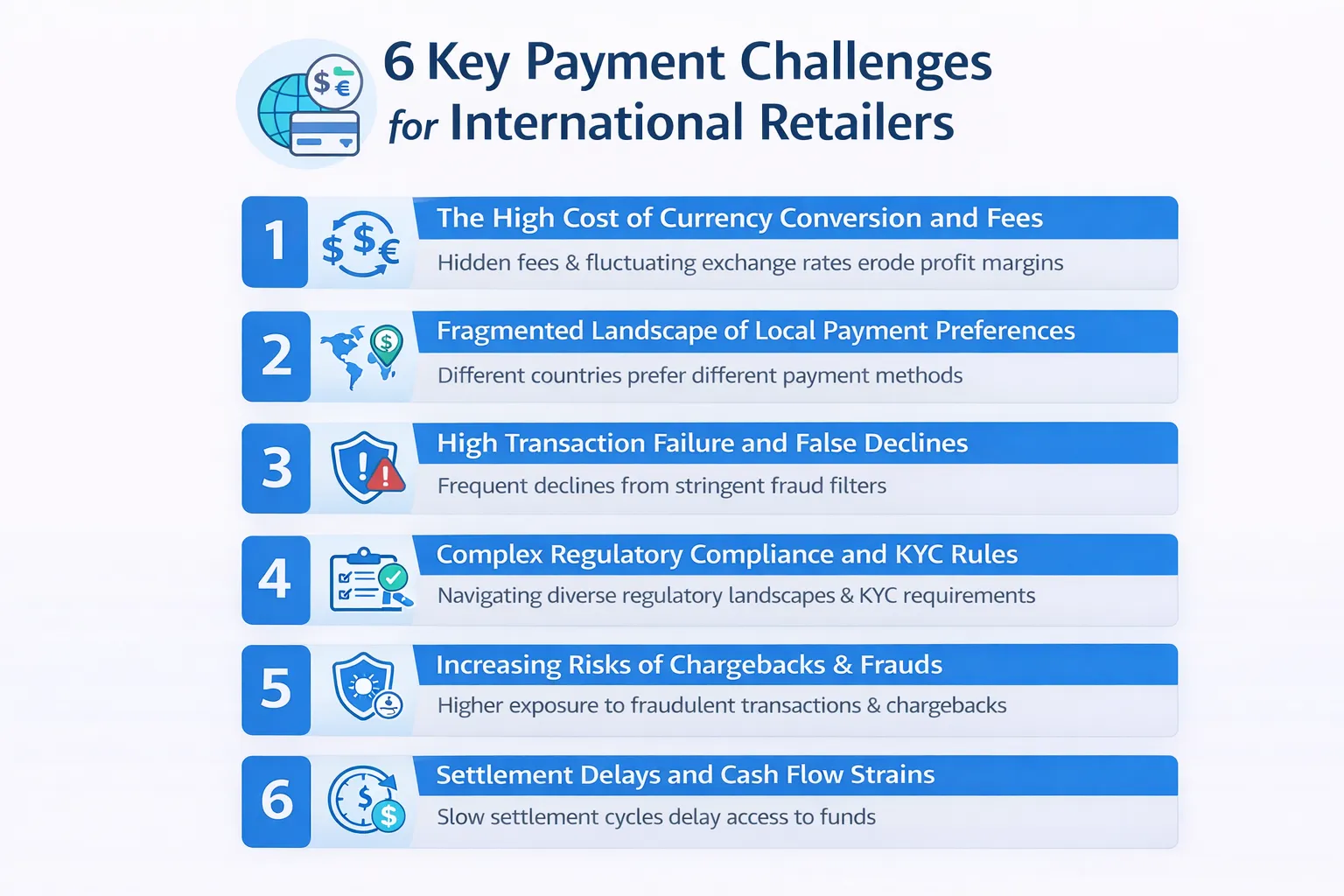
Going global offers massive potential, but cost structures can be scary for merchants who are not ready. Success isn’t just a great product; it’s a strategy to overcome the complex technical and regulatory landscape of international ecommerce payments.
1) The High Cost of Currency Conversion and Fees
International online merchants face the difficulty of dealing with the unstable world of international exchange. Unexpected fees at the time of checkout can cause consumers to abandon their shopping carts faster than any other factor. This is normally because of the hidden fees charged by intermediary banks.
The specific financial pressures on merchants include:
- Settlement Risk: Fluctuating exchange rates can erode profit margins before funds clear.
- Intermediary Costs: Multiple banks often take a percentage during international wire transfers.
- Conversion Fees: Standard processors may charge up to 5% above mid-market rates.
To protect your revenue, moving toward a multi-currency payment processing setup is essential for protecting margins. By holding local denominations, you avoid forced conversions and ensure a transparent, "local-like" experience for your global clients.
2) Fragmented Landscape of Local Payment Preferences
A significant barrier to global conversion is the assumption that credit cards are the universal standard. In practice, payment preferences are extremely localized and a lack of local options causes instant friction. If you want to reach a worldwide audience, your checkout needs to align with local payment preferences through proper payment localization strategies.
Key regional preferences include:
- Europe: Heavily relies on bank transfers like iDEAL in the Netherlands or SEPA.
- Asia: Dominated by digital wallets such as Alipay and WeChat Pay.
- Latin America: Uses unique voucher-based systems like Brazil’s Boleto Bancário.
By localizing your payment methods, you build immediate trust with the consumer. Integrating these diverse options ensures that you aren't just visible in a new market, but actually accessible to the people living there.
3) High Transaction Failure and False Declines
International transactions face a much higher risk of being flagged by automated fraud systems. When a customer in Asia buys from a European store, the issuing bank often treats the distance as a red flag, leading to "false decline." This results in lost revenue from legitimate customers who may never return.
These declines are often caused by:
- Mismatched Data: Discrepancies between billing addresses and IP locations.
- Strict Security Filters: Legacy banking systems are rejecting unfamiliar merchant IDs.
- Lack of Local Acquiring: Processing payments through a foreign bank instead of a local one.
Reducing these failures requires a sophisticated payment routing strategy supported by the right payment providers and gateways. Utilizing local entities or optimized gateways can significantly improve your authorization rates and ensure a smoother customer journey across different jurisdictions.
4) Complex Regulatory Compliance and KYC Rules
Operating in different countries means adhering to different sets of rules. Be it the EU’s GDPR & PSD2 regulations or different sets of Anti-Money Laundering regulations, the complexity of regulatory compliance is high. Operating without proper legal guidance can put the entire operation at risk of severe financial penalties.
Adhering to complex regulatory compliance involves different sets of rules, which are as follows:
- KYC Rules: Identifying the customers to curb financial criminal activities.
- Data Privacy: Ensuring data is stored according to different regional regulations.
- Tax Rules: Handling Value Added Tax (VAT) or Sales Tax according to different countries.
Establishing a legal foundation is the only way to operate safely. Many successful merchants use corporate services providers to set up the necessary legal structure to comply with regulatory requirements in high-growth regions.
5) Increasing Risks of Chargebacks & Frauds
Unlike the false declinescovered above - where legitimate customers get wrongly blocked - this is theopposite problem: bad actors successfully getting transactions through.E-commerce operations in different countries are highly vulnerable to malicious& friendly fraud, and dispute resolution & recovering funds areextremely difficult when the operation involves different legal systems. For manymerchants, the cost of resolving disputes is higher than the value of the sale.
These payment risks incross-border e-commerce compound quickly, since a single unresolved disputecan trigger account holds or higher processing fees down the line.
Fraud risks faced by online stores are as follows:
- Account Takeover: Hackers use stolen login credentials for international transactions.
- Triangulation Fraud: Using legitimate storefronts for processing stolen credit cards.
- Dispute Resolution: Difficulty in delivering products to international addresses.
To curb these risks, online stores must use advanced fraud prevention tools and 3D Secure protocols & AI-powered fraud detection tools. Balancing security & user experience is the key to saving the company’s revenue from international cyber criminals.
Building consistent paymentrisk control for cross-border e-commerce into your checkout flow, ratherthan treating fraud prevention as an afterthought, helps keep both approvalrates and dispute rates in check.
6) Settlement Delays and Cash Flow Strains
The time it takes for money to move from the customer’s pocket to your business account will vary significantly. Traditional SWIFT transactions take almost a week to settle. This creates a huge gap in the cash flow for a business to replenish stock or invest in marketing campaigns.
These settlement delays are usually caused by:
- Banking Holidays: Holidays in the intermediate country where the funds are being transferred.
- Compliance Holds: Manual processing by the bank for high-value transactions.
- Batch Processing: Gateway processing funds in batches on a weekly or monthly basis.
Settlement delays can hinder a business’s growth and its capability to capitalize on market trends. Accessing cutting-edge payment processing solutions for ecommerce with more efficient settlement cycles is essential to maintain the growth momentum necessary to compete on a global stage.
Reliable payment settlementfor cross-border e-commerce, with predictable timelines and fewerintermediary holds, gives merchants the confidence to reinvest revenue faster.
Understanding these challenges side by side makes it easier to identify where your payment setup needs improvement.
Each of these challenges can significantly impact your growth if left unaddressed.
The key is to proactively optimize your payment infrastructure before scaling internationally.
Strategic Solutions for Global Payment Success
To overcome the friction of international commerce, merchants must shift from a "borderless" mindset to a "local-first" strategy. Scaling an e-commerce store requires a robust financial infrastructure supported by reliable e-commerce payment solutions.
Partnering with Specialized Corporate Services
Navigating the legalities of international expansion is often the biggest bottleneck for growing brands. Partnering with experts like FirmEU ensures your business foundation is compliant and optimized from day one. They streamline company formation and banking integration, allowing you to focus on scaling your brand while they handle the complex regulatory and structural hurdles of global commerce.
This professional partnership provides:
- Compliant Company Formation: Expert handling of paperwork and filings in reputable jurisdictions.
- Streamlined Banking: Facilitating the opening of business accounts tailored for high-volume e-commerce.
- Ongoing Support: Ensuring your business stays aligned with evolving international tax and privacy laws.
Establishing a Local Business Presence
One of the most effective ways to bypass high international fees and transaction failures is to establish a legal entity in your primary target market. By forming a company in regions like the European Union, you transition from being an international merchant to a domestic one in the eyes of local banks. This move unlocks higher authorization rates and lower interchange fees compared to standard cross-border rates.
Leveraging Multi-Currency Business Accounts
Modern financial tools allow you to accept and hold foreign currencies without forced conversions. Utilizing multi-currency business accounts enables you to collect funds like a local business like a local, protecting your profit margins from volatile exchange rates and hidden FX fees while providing a transparent checkout experience for your customers.
The Verdict
The potential of cross-border e-commerce is undeniable, but global success requires navigating complex financial and regulatory hurdles. But achieving your business objectives in this worldwide marketplace is fraught with many financial and regulatory obstacles. With so many potential stumbling blocks to successful sales from failed transactions and expensive conversion costs to international rules and restrictions, it can be a struggle not to get bogged down in global e-commerce complications. But the right financial approach to your business means you can take these challenges and make them opportunities.
Ready to Fix Your Cross-Border Payment Challenges?
Don’t let payment failures, delays, or hidden costs slow down your global growth. With the right setup, you can turn these challenges into opportunities.



FAQs
What are the biggest payment challenges in cross-border e-commerce?
The most common challenges include currency conversion fees, lack of local payment methods, high transaction failure rates, regulatory compliance issues, fraud risks, and settlement delays.
Why do international payments fail more often than domestic ones?
International payments are more likely to fail due to stricter fraud checks, mismatched customer data, lack of local acquiring, and differences in banking systems across countries.
How can I reduce cart abandonment in global e-commerce?
You can reduce cart abandonment by offering local payment methods, transparent pricing (including fees), and a smooth checkout experience tailored to each region.
How do multi-currency accounts help e-commerce businesses?
Multi-currency accounts allow businesses to hold and receive payments in different currencies, avoiding unnecessary conversion fees and protecting profit margins.
How can businesses stay compliant with international payment regulations?
Businesses need to follow KYC, AML, tax regulations, and data privacy laws like GDPR. Partnering with experts or using compliant financial solutions can simplify this process.
What is the best way to improve payment success rates globally?
No. FirmEU is not a bank or financial institution. We operate as an independent matchmaking platform, connecting businesses with verified financial partners. All onboarding, KYC, and approval decisions are handled directly by the financial institution.
Still Have Questions?
Our sales team would be more than happy to assist with any futher inquiries



Contact Us

International Payment Solutions
Find the Right Banking and Payment Processing Partner for Your Business
Tell us about your company, and we’ll match you with the most suitable global banking or payment providers from our verified network.
Get Matched