
Payment Gateway vs Payment Aggregator vs Payment Processor: What’s the Difference?

Garry
November 3, 2026
1
minutes
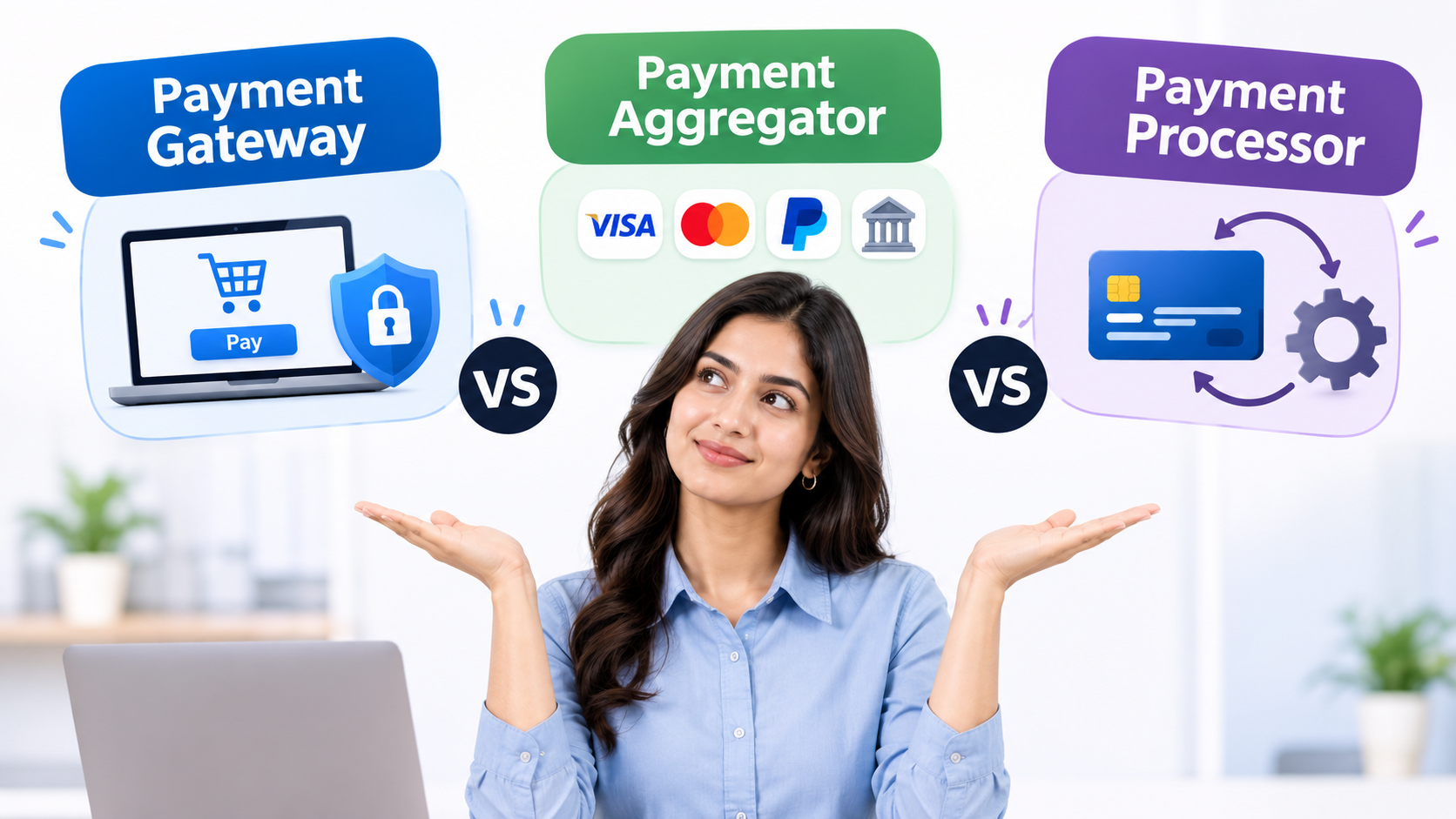

A payment gateway, a payment aggregator, and a payment processor all support digital payments for businesses. However, they all perform different functions within the payment ecosystem.
For businesses, understanding the difference matters when you are setting up an online store, accepting international payments, launching a subscription business, or expanding into new markets. Your choice can affect checkout integration, merchant onboarding, transaction fees, settlement arrangements, and the support available when payments fail.
The main confusion for businesses arises when many providers combine multiple payment services under one offering. A company may provide checkout technology, process transactions, and help businesses accept payments through a single platform.
This guide explains payment gateway vs payment aggregator vs payment processor, how each works, how they differ, and what businesses should consider when choosing a payment solution.
A Quick Comparison
The simplest way to understand how all of them and their services work is to look at the role each one performs.
That’s a comparison overview of a payment gateway, a payment aggregator, and a payment processor. Now let’s dig deep into each role to understand what they do and when businesses need them.
What Is a Payment Gateway?
A payment gateway refers to technology used to transmit payment information securely from a customer’s checkout to the payment infrastructure that will process the payments. After the purchase is made by a customer via an online shopping site, the payment gateway facilitates sending the request for payment authorization and receiving the resulting payment status.
What Does a Payment Gateway Do?
A payment gateway may provide features such as:
- Hosted checkout pages
- Website and mobile app integrations
- Secure transmission of payment information
- Payment status notifications
- Support for selected payment methods
- Tokenization and related security features
- Integration tools for order management and reporting
While a gateway-only product is not guaranteed to include the merchant account, fund collection for the merchant, or settlement of the money to a business’s bank account, these additional functions depend on other participants and products involved in the transaction process.
When Does a Business Need a Payment Gateway?
Businesses involved in accepting payment through a website, mobile app, or other digital channels need a payment gateway. Small businesses looking to accept credit card payments should also compare available payment options and integration requirements. For example, an online retailer may need a gateway to connect its checkout to the systems that authorize card payments. A software company may use a gateway as part of its subscription checkout.
However, before choosing a payment gateway, businesses should consider website platform, supported currencies, customer markets, integration requirements, security features, and compatibility with your processor or acquiring arrangement.
What Is a Payment Aggregator?
A payment aggregator helps businesses accept payments through a shared service instead of requiring every merchant to establish all the necessary payment relationships independently.
Depending on the model and jurisdiction, an aggregator may provide merchant onboarding, access to payment methods, transaction reporting, payment collection, and settlement.
Benefits of a Payment Aggregator
- Simplified onboarding
- Multiple payment methods
- Centralized reporting
- Reduced integration work
- Support for smaller businesses
However, these benefits can vary and generally depend on the payment aggregator provider. Businesses should still review approval requirements, pricing, payout timing, supported markets, and contractual restrictions before signing up.
What Should Businesses Check Before Choosing an Aggregator?
Before choosing a payment aggregator, a business should consider how easily you can start accepting payments and the payment arrangement behind the service. Make sure you ask every minute detail, such as who collects customer funds, which entity settles your payouts, how settlement timing is determined, and what happens when a payment is disputed or an account is reviewed.
Ensure that the aggregator is compatible with your industry, countries where you operate, transaction volumes expected, and modes of payment. If your business works internationally, make sure the platform is compatible with the countries and currencies used for transactions.Businesses expanding into international markets can explore global payment solutions to understand their available payment options.
What Is a Payment Processor?
A payment processor handles the technical and operational work required to process payment transactions between the relevant participants in the payment ecosystem. Card transaction processing includes routing of authorization requests, communication with the payment network and banks, responding to the transaction, and handling processes related to the settlement of transactions.
The processor usually works in the background. The customer is only aware of the checkout process through the gateway or the payment system platform.
What Does a Payment Processor Do?
Depending on its service model, a processor may provide:
- Transaction routing and processing
- Connections to payment networks and financial institutions
- Authorization request handling
- Transaction status reporting
- Support for clearing and settlement processes
- Payment infrastructure for online or in-person transactions
- Technical tools for merchants, gateways, or payment platforms
When Does a Business Need a Payment Processor?
AcAccess to transaction processing is necessary for accepting the digital currencies that a business can accept. Businesses considering cryptocurrency payments can also learn how to accept Bitcoin payments for business. A business might not have to sign up with a processor for this purpose.
It is possible that the payment aggregator or full-service payment processor already includes processing in its services. An enterprise might want an arrangement where there will be a gateway, a processor, and an acquiring arrangement.
The kind of arrangement one opts for depends upon their transaction volume, market, type of payment, and other considerations.
How Do a Gateway, Aggregator, and Processor Work Together?
Most businesses use these services in combination rather than as an alternative. Consider an example of an international online store selling products to customers in several countries.
When a customer visits the store and enters their payment information through the checkout. After this, the gateway securely transmits the payment request and the processor routes the transaction through the relevant payment infrastructure. Depending on the setup, an aggregator may provide the merchant acceptance arrangement and collect and settle funds under its service model.
Customer checkout → Payment gateway → Processing and banking infrastructure → Applicable collection and settlement arrangement → Business payout
This is a theoretical flow rather than a standardized transaction sequence. Different suppliers may combine different processes together, and the precise flow may be determined by the mode of payment and other factors.
The merchant should understand four things before going live:
- Which provider supplies the checkout technology
- Which entity processes the transaction
- Which organization is responsible for collecting and settling funds
- Which contract governs fees, disputes, refunds, and account restrictions
Knowing these details makes it easier to resolve failed payments, trace missing payouts, and understand the responsibilities of each provider.
How FirmEU Helps Businesses Explore Payment Solutions
Comparing gateways, aggregators, and processors can be difficult because providers may combine these functions or use similar terms to describe different services.
FirmEU helps businesses explore suitable banking and payment processing services through its network of more than 250 verified partners. Its matchmaking approach considers factors such as the business model, operating markets, transaction requirements, and preferred payment methods.
Before choosing a provider, businesses should identify their practical requirements and explore potential partners whose services may align with them. Our team can help businesses explore options for:
- Online and international payment acceptance
- Payment processing for specific industries
- Cross-border payments and multi-currency requirements
- Payment providers that support their operating markets
- Solutions aligned with their integration and transaction needs
Conclusion
Payment gateways, payment aggregators, and payment processors support different parts of the payment ecosystem.
A gateway securely connects checkout to payment infrastructure. A processor handles transaction-processing functions. An aggregator provides a broader arrangement that helps merchants accept payments and may manage collection and settlement, depending on its model and jurisdiction.
These roles are not always separate products. One provider may offer all three, while another may specialize in a single part of the payment flow. That’s why, before choosing a solution, examine the full service offering, merchant onboarding process, payment methods, fees, settlement terms, security controls, and market coverage. Understanding who performs each role will help you select a payment setup that suits your business today and supports its future growth.
Looking for a suitable payment solution for your business? Connect with FirmEU to explore potential payment partners based on your business model, markets, and payment requirements.


FAQs
1. What is the main difference between a payment gateway and a payment aggregator?
The functions of a payment gateway mainly include providing the necessary technology to securely transfer the information about payments from the checkout to the payment system. The payment aggregator will offer a more comprehensive payment acceptance solution for the merchants and possibly handle onboarding, collection, and settlement.
2. What is the difference between a payment aggregator and a payment processor?
The payment aggregator acts as an intermediary enabling merchants to acquire payment acceptance through one common system or service. The payment processor performs transaction-processing tasks via the payment system(s). One provider may provide both services.
3. Is a payment gateway the same as a payment processor?
No. A gateway is responsible for secure transmission of the payment data to the processor during the checkout process. A processor performs the actual processing of transactions. Some processors provide both the services together, hence the confusion.
4. Does a business need a payment gateway, aggregator, and processor?
The business will require access to the functions needed to receive and process their selected payment options; however, the business does not necessarily require three different companies. One company may provide all three elements of the payment process in one deal.
5. Which payment solution is best for a small business?
Small firms might also prefer to choose a bundled provider or aggregator due to their ease of implementation. Nonetheless, it is necessary to consider other aspects such as location of a business, the industry, payment types, and fees among others.
No. FirmEU is not a bank or financial institution. We operate as an independent matchmaking platform, connecting businesses with verified financial partners. All onboarding, KYC, and approval decisions are handled directly by the financial institution.
Still Have Questions?
Our sales team would be more than happy to assist with any futher inquiries



Contact Us

International Payment Solutions
Find the Right Banking and Payment Processing Partner for Your Business
Tell us about your company, and we’ll match you with the most suitable global banking or payment providers from our verified network.
Get Matched