
TAMS & Travel Payment Structures Explained for Businesses

Garry
April 2, 2026
1
minutes
.webp)

At first glance, a travel business looks quite straightforward. A customer books a trip, makes a payment, and the business earns revenue. That’s how most people perceive it from the outside and honestly, many founders follow this approach when they start.
But the minute you start looking at how money actually flows behind the scenes, things actually become more complex. A single booking often involves multiple parties like hotels, airlines, local operators and the business itself is usually earning only a margin from the total transaction value.
Let’s get this straight through a simple example. A customer pays €2,000 for a travel package. On paper, it looks like the business received €2,000. But in reality, a significant part of that amount is passed on to suppliers and the actual earnings might be just a fraction of it. This is exactly where models like TAMS (Travel Agent Margin Scheme) come into play, changing how TAMS VAT travel agents calculations are made and how revenue should be interpreted.
Now that’s the part where things start to create friction.
From a payment processor’s perspective, they see the full €2,000 coming into your account. But from a business and tax standpoint, your actual revenue might only be €200–€300. This difference between "transaction value" and "real earnings" often creates confusion, not just for businesses, but also for banks and payment providers, especially when there is no clarity in travel agency payment processing and payment solutions for travel agencies.
Over time, I’ve noticed that most travel businesses don’t face issues because they can’t accept payments. The real challenge comes when their payment structure is heavily not aligned with how their business actually operates. Then the mismatch happens which later on leads to challenges like unexpected declines, account reviews, settlement delays or even onboarding rejections.
This becomes even more important when you are operating across multiple countries. Different jurisdictions often come with different expectations, tax treatments and compliance requirements. What works in one region might not work in another region and suddenly your payment setup needs more thought than just merely “choosing a provider.”
At FirmEU, this is something we discuss quite often with travel businesses. Instead of starting with “which payment processor should you use,” we usually start with a different question, and whether your travel industry merchant accounts are set up to support it. Because in travel, especially when TAMS is involved, that alignment is what makes the difference between smooth operations and constant friction.
In this article, I’ll walk you through how TAMS works in practical terms, how travel payment structures are actually set up, and what you need to get right to avoid common issues.
Payment declines slowing your travel business?
A better payment structure can improve approvals and reduce failures.

Pre-requisites A Business Should Know
1) Your actual revenue in travel is usually only 10 to 20%of the total booking value so your entire payment and tax setup, including your approach to TAMS VAT travel agents obligations, must be built around margin not volume
2) Payment processors typically charge around 2.5 to 4.5% and may hold 5 to 15% as rolling reserves due to the high risk nature of travel transactions
3) Most of the booking amount often 70 to 90% is passed to suppliers so having a clear and structured fund flow through proper travel industry merchant accounts is critical to avoid compliance and banking issues
4) Operating across countries introduces additional costs like 1 to 3% in currency conversion along with different tax rules which directly impact your margins
5) Travel businesses usually face refund cycles of 7 to 30 days and chargeback rates around 0.5 to 1% so maintaining a financial buffer is essential to keep payment operations stable
What is TAMS (Travel Agent Margin Scheme) — Explained Simply
TAMS, or the Travel Agent Margin Scheme, sounds complicated when you hear it for the first time. But if you look at it from a practical business perspective, it’s actually quite straightforward.
Instead of taxing the full amount that a customer pays, TAMS focuses only on the margin you earn.
Let’s return to the same example.
A customer pays an amount €2,000 for a travel package. Out of that you might pay €1,700 to hotels, airlines or other suppliers. What you actually keep is €300.
Under normal taxation,businesses might expect tax to apply on the full €2,000. But under TAMS VATtravel agents rules, the tax is applied only on that €300 margin.
That’s the core idea.
Where things get interesting is how this reflects in your payment flow.
From a system perspective, youraccount still receives the full €2,000 as part of standard TAMS paymentprocessing. The payment processor, bank, and even compliance checks see theentire transaction value, not just your margin. But your accounting and taxreporting are based only on what you earn.
This creates a gap between:
- what is processed
- what is earned
- and what is taxed
And this gap is exactly where most misunderstandings begin.
To simplify it further, here’s how TAMS works in real terms:
- You collect the full booking amount from the customer
- You pay suppliers (hotels, airlines, operators) their share
- You retain a margin as your actual revenue
- Tax is applied only on that retained margin
Now, on paper, this looks efficient and logical.
But in practice, especially when payments are involved, it creates complexity.
Because payment providers don’t operate on “margin logic.” They operate on transaction flow and risk assessment. And when they see large incoming amounts with partial payouts, it raises questions about business models, fund flows, and exposure.
This is why TAMS is not just a tax concept.
It directly affects:
- how your payment setup should be structured
- how processors evaluate your business
- and how smoothly your transactions move
At FirmEU, this is one of thefirst things we clarify with travel businesses. Many of them understand TAMStravel company payments from a tax perspective, but haven't aligned theirpayment flow with it. Once that alignment is done, a lot of operational issuesstart resolving on their own.
Why TAMS Creates Payment & Banking Challenges
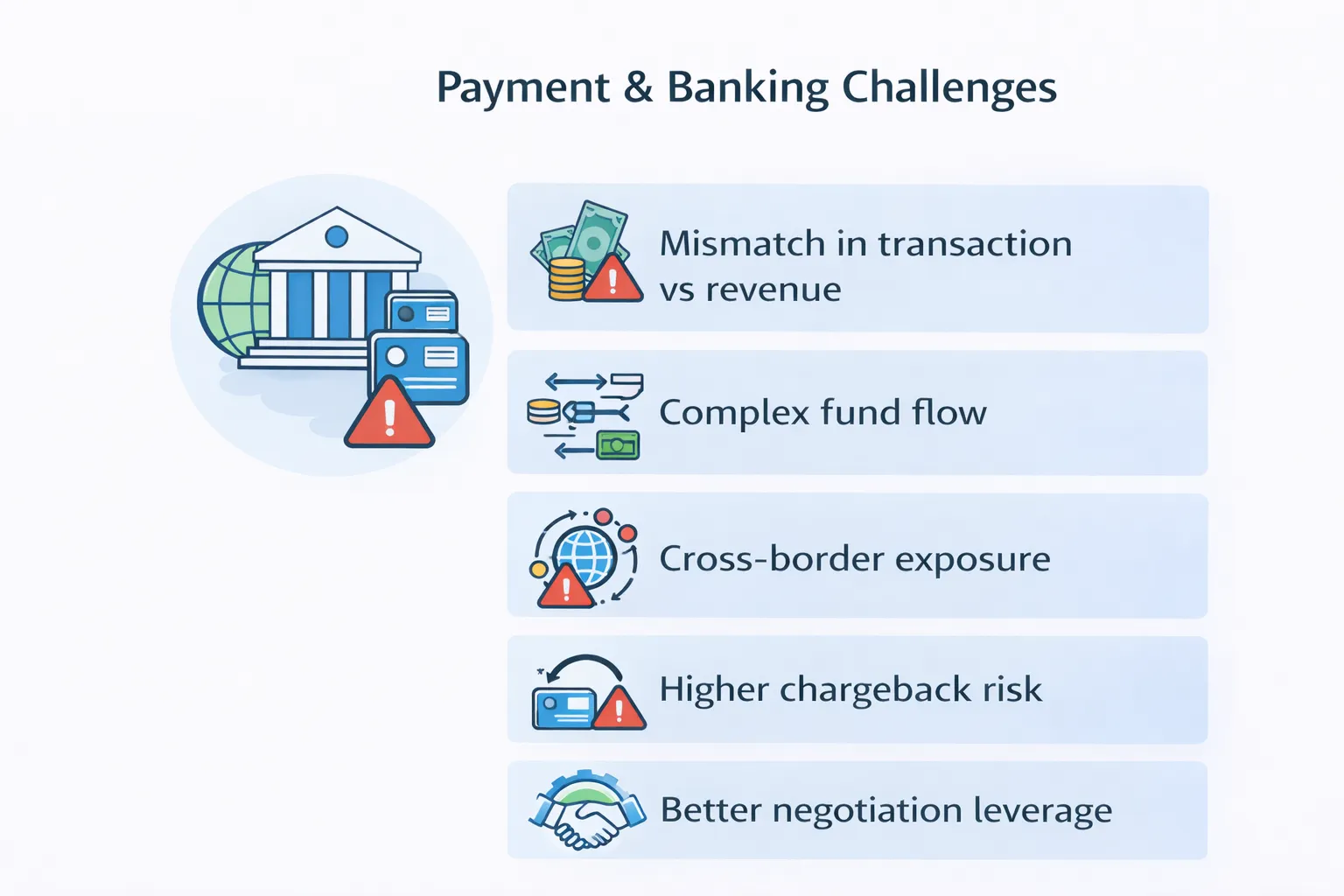
On paper, Payment Solutions for TAMS is simple. In reality, it creates confusion especially for payment providers.
The issue is not the model itself, but how it looks from the outside. A processor sees full transaction amounts coming in, but doesn’t always understand that the business is only keeping a margin. That difference often raises questions around risk, fund flow, and business clarity.
And once that happens, things start slowing down.
This is one reason why TAMS payment processing requires a payment setup that clearly reflects howrevenue, supplier payouts, and margins are handled.
Here’s where most challenges come from:
- Mismatch in transaction vs revenue: Large incoming payments, but smaller retained earnings can look unusual to processors
- Complex fund flow: Money flows between multiple parties (customer → business → supplier) which adds layers to verification
- Cross-border exposure: Travel businesses usually deal with multiple countries, currencies and regulations at the same time, adding another layer to travel agency payment processing
- Higher chargeback risk: Travel includes future services, cancellations and refunds, which increases scrutiny
We’ve seen businesses get flagged not because they were doing anything wrong, but because their structure wasn’t clearly understood by the provider.
And that’s usually the turning point — when businesses realize this is not just about accepting payments, but about structuring them properly.
How Travel Payment Structures Actually Work
Travel payments look simple from the outside, but the flow is slightly different once you break it down.
Effective travel agency payment processing depends on understanding this flow because processors assess risk based on how funds move through the business.
In most cases, it follows a clear and structured sequence.
- First, the customer pays the full booking amount. This is the total value of the trip, even though the business is not keeping all of it.
- Then the business holds the funds temporarily. A large portion of this amount is already meant for suppliers like hotels or airlines.
After that, payments are made to these suppliers, either immediately or closer to the travel date. Finally, the business keeps only the margin, which becomes the actual revenue as part of standard TAMS travel company payments.
The problem is that payment providers don’t see these steps the same way. They only see money coming which is flowing in and going out. Uncleared structure can create confusion and sometimes lead to unnecessary friction.
This is why aligning your payment setup with this flow is important. When the structure shows how your business actually works, things tend to run much more smoothly.
Also read Who Accepts XRP as Payment: Your Ultimate Guide to XRP Transactions
Common Travel Business Models (And Their Payment Impact)
Not all travel businesses operate the same way and this is where the confusion comes. Two companies can be in the same industry, but their payment structure can be completely different depending on how they operate.
Let’s look at the common models.
Travel Agents (TAMS Applicable)
This is where TAMS usually applies and where TAMS travel company payments are often structured around margin-based revenue rather than total booking value.
The agent collects the full amount from the customer then pays the suppliers and keeps only the margin. From a payment perspective, this creates a layered flow that needs to be structured properly and carefully, often requiring dedicated travel industry merchant accounts to manage supplier payouts.
Tour Operators
Here, the business often builds and sells complete packages. In some cases, they directly contract with suppliers, which gives them more control over pricing and payments. The structure is slightly cleaner, but still involves multiple fund movements.
Online Travel Agencies (OTAs)
OTAs act more like platforms. Sometimes they only enable the booking and earn a commission, while in other cases they also manage payments. This creates mixed payment flows which can be tricky for processors to interpret.
Hybrid Models
Many modern travel businesses don’t fit into one category. They combine elements of agents, operators, and platforms. This flexibility is good for business, but it makes payment structuring more complex.
Also Read How to Integrate Multiple Payment Processors on Your Website?
How FirmEU Helps Travel Businesses Structure Their Payments
At this stage, most travel businesses don’t actually need more providers — they need clarity in how everything is set up.
That’s where we usually come in.
At FirmEU, we work with travel companies to understand how their business operates, how funds move, and whichregions they are dealing with. Based on that, we help align their payment structure so it matches both their business model and what payment providers expect, particularly when TAMS payment processing is involved.
This can involve:
- Identifying processors that support travel and TAMS-based models, including businesses that require travel industry merchant accounts
- Structuring fund flow in a way that avoids confusion
- and connecting businesses with the right partners across Europe
We also help businesses evaluate travel industry merchant accounts that are designed to support complex supplier payouts, international transactions, and travel-related risk profiles.
Facing payment delays or declines?
A strong structure keeps your transactions stable, improves approval rates, and supports growth without disruptions.



FAQs
What is the biggest mistake travel businesses make with payments?
Most businesses treat total booking value as revenue instead of margin which creates issues with taxes reporting and payment provider expectations
Do all payment processors support TAMS based models?
Many providers do not fully understand margin based models so choosing a travel friendly processor with experience in travel agency payment processing is important to avoid delays or rejections.
Why do payment providers hold reserves for travel businesses?
Travel involves future delivery cancellations and refunds which increases risk so providers hold a percentage to cover potential disputes
Can poor payment structuring lead to account suspension?
Yes unclear fund flow and mismatch between transactions and actual earnings can trigger compliance reviews and even account shutdowns
Is it better to use one payment provider or multiple?
Relying on one provider can be risky so many travel businesses use multiple setups to ensure continuity and reduce dependency
How does the TAMS VAT travel agents rule affect refunds and cancellations?
No. FirmEU is not a bank or financial institution. We operate as an independent matchmaking platform, connecting businesses with verified financial partners. All onboarding, KYC, and approval decisions are handled directly by the financial institution.
Still Have Questions?
Our sales team would be more than happy to assist with any futher inquiries



Contact Us

International Payment Solutions
Find the Right Banking and Payment Processing Partner for Your Business
Tell us about your company, and we’ll match you with the most suitable global banking or payment providers from our verified network.
Get Matched