
What Is A Multi-Currency Account And How Does It Work?

Garry
May 29, 2026
1
minutes


Have you ever wondered why some businesses struggle with international payments even when they already have a bank account for transactions? The problem is often not the payment itself. In many cases, companies start facing delays, conversion pressure, and settlement confusion because their financial setup was never designed for international activity in the first place.
As global transactions continue increasing, companies now deal with suppliers, clients, and operational payments across multiple currencies regularly. This is where multi-currency accounts have become relevant for international operations.
At FirmEU, businesses often look for a financial structure that supports smoother cross-border payment coordination and more flexible interaction with payment handling. In this blog, we will explore what a multi-currency account is, how it works, and why businesses use it within international operations as part of modern international business banking practices.
Managing international payments across multiple currencies?
Get better payment visibility, smoother settlements, and stronger coordination for global business operations.

What Is A Multi-Currency Account?
A multi-currency account is a financial account that allows companies or individuals to hold, send, receive, and manage more than one currency within the same account structure.
Rather than opening separate bank accounts for every currency, companies can manage multiple currencies together under one financial environment. This helps simplify international transaction handling and improves visibility across global payment activity.
For instance, a business operating internationally may receive USD payments from one client, hold EUR for supplier settlements, and manage GBP transactions for operational expenses. A multi-currency account helps coordinate these activities more efficiently.
The purpose is not simply holding different currencies. The large goal is improving how international payments move across operations. In many cases, it can serve as a more flexible alternative to maintaining a separate foreign currency account for every currency used by the business.
Why Businesses Use Multi-Currency Accounts
International business activity rarely operates through one currency alone anymore. Companies working across different countries and regions often manage payments from different countries within the same operational cycle. Due to this, businesses usually need more flexible financial coordination, often through a multi-currency business account.
- Managing International Transactions
Businesses managing global activity may receive payments in several currencies at the same time. Without a structured setup, every international payment may require separate conversion processes before settlement is completed. Over time, this process creates additional operational pressure internally.
A multi-currency account helps companies manage incoming and outgoing international transactions more efficiently without constantly moving funds between disconnected accounts.
- Reducing Currency Conversion Pressure
Frequent currency conversion can create timing issues and reporting inconsistencies, especially when businesses operate across multiple regions regularly.
That is why holding different currencies separately within one account structure is the finest way. This allows businesses to coordinate settlements more strategically instead of converting funds immediately after every transaction. Thus, it supports hassle-free financial management overall.
How Multi-Currency Accounts Actually Work
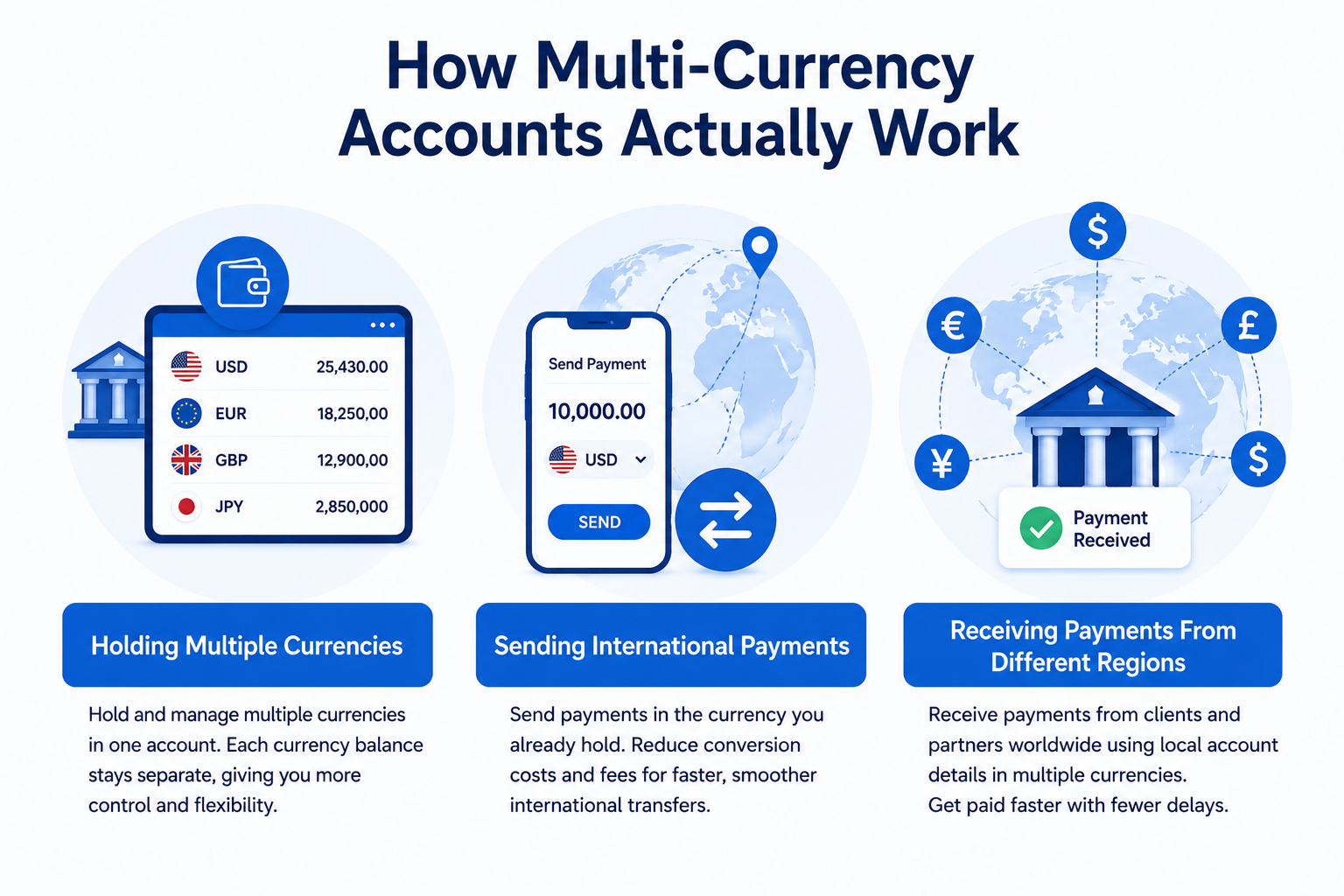
The structure behind these accounts is usually designed to support international payment coordination more efficiently. Providers may operate differently, but the core functionality remains the same across the majority of systems. For businesses asking how does a multi-currency account work, the answer lies in its ability to manage multiple currencies within a single account structure while keeping funds separated by currency type.
- Holding Multiple Currencies
Businesses can hold various types of currencies at the same time within the same account environment. Funds remain separated by currency rather than automatically converting after every payment.
This gives businesses more flexibility when managing international settlements. For example, a business receiving USD payments may keep those funds available for future USD supplier payments instead of converting immediately into another currency.
- Sending International Payments
Multi-currency accounts also support international payment activity across different regions. As stated above, companies can send payments using the currency already held within the account structure. This reduces unnecessary conversion activity and helps improve settlement coordination.
In many cases, businesses also gain clearer visibility across international payment flows because multiple currencies remain organized within one system.
- Receiving Payments From Different Regions
Some multi-currency account providers also support local receiving details for different currencies. This allows businesses to receive international payments more efficiently from overseas clients or partners.
Such experience becomes even more practical for companies operating globally because transaction handling feels less fragmented across countries.
Why International Businesses Prefer Them
As businesses expand internationally, managing payments through standard single-currency structures often becomes more difficult. Multi-currency accounts help reduce some of this operational complexity. A multi-currency business account can provide greater flexibility when handling payments, settlements, and reporting across regions.
- Better Payment Coordination
International businesses usually process payments across several markets simultaneously. A multi-currency setup helps coordinate these settlements more clearly. In simple words, they don’t rely on separate banking structures for every currency. In simple words, this improves operational visibility internally.
- Simpler Financial Management
Managing several international bank accounts separately can increase the administrative workload significantly. Businesses may need to track:
- Separate balances
- Multiple settlement timelines
- Different payment systems
- International transaction visibility
A centralized structure helps simplify financial coordination across international activity.
Common Situations Where Businesses Use Them
Multi-currency accounts are now used across many international business models because payment flexibility has become increasingly important.
- Import And Export Operations
Businesses that engage in international trade often receive and send payments across different currencies regularly. A multi-currency setup helps support smoother settlement partnerships between suppliers and buyers operating internationally. This becomes especially useful once trade activity expands across several regions.
- Remote And International Teams
Some businesses pay contractors, partners, or operational teams located in different regions. Multi-currency accounts help manage these payments without any hassle while reducing unnecessary conversion movement. The process becomes easier to manage operationally.
- Online And Digital Businesses
Digital companies frequently sell products or services internationally. As customer payments arrive in different currencies, businesses may require financial systems capable of supporting broader international transaction activity. This multi-currency option, therefore, helps in providing operational flexibility.
Challenges Businesses Still Face
Although multi-currency accounts improve flexibility, businesses may still experience operational challenges depending on how their financial structure is organized.
- Different Provider Capabilities
Not every provider supports the same currencies, transaction volumes, or international settlement requirements. Some businesses may require:
- Solid cross-border coordination
- Wider currency coverage
- Operational reporting visibility
- Higher transaction support
It is very important to opt for the right provider, because choosing the wrong provider can create operational limitations later.
- Compliance And Verification Processes
International financial activity often includes regulatory procedures and onboarding reviews. Businesses operating across several regions may therefore experience additional verification requirements depending on transaction activity, as per the rules and compliance of the particular region. This is a standard part of international financial systems.
- Growing Transaction Complexity
As companies grow globally, financial partnerships naturally become more layered and organized. More currencies, suppliers, settlements, and transaction timelines improve operational complexity gradually. However, without proper management, payment visibility may become complex to manage over time.
Why Financial Structure Matters
However, a multi-currency account does not automatically resolve all payment problems faced in international trade. The overall financial structure that backs up the company operations will always play an important role.
Companies typically need integration across several areas:
- Payments
- Bank access
- Settlements
- Currencies
- Reporting
If the integration of these components is missing, international payments can become complicated for companies. This is one reason why companies look into financial structures that suit their international operations.
The Role Of Financial Matching
Different businesses operate under very different international payment conditions. Some manage supplier settlements globally, while others process digital customer payments across several regions simultaneously.
Due to this, companies often need financial partners aligned with their payment patterns and operational requirements.
At FirmEU, businesses are connected with banking and payment partners that support international financial coordination, multi-currency activity, and cross-border operational requirements. The main attention remains on assisting businesses to build payment structures streamlined with global operational activity.
Conclusion
To conclude, multi-currency accounts help businesses manage international payments more efficiently by allowing multiple currencies to operate within one financial structure. As global business activity continues growing, these accounts have become increasingly useful for improving payment coordination and reducing operational complexity across regions.
However, the effectiveness of a multi-currency setup still depends heavily on the broader financial structure supporting international operations. Businesses that prioritize organized payment coordination and visibility early usually manage international activity more smoothly as operations expand.
Growing globally requires more than just handling different currencies.
Build a stronger financial structure with better cross-border coordination and multi-currency payment flexibility.



FAQs
Why do companies choose multi-currency accounts over separate bank accounts?
Managing separate bank accounts for every currency can become tough once international transactions increase. A multi-currency account helps companies manage various currencies within one structure, which improves payment visibility and reduces operational complications.
How does a multi-currency account help with international payments?
These accounts enable businesses to receive, hold, and send various currencies without conversion after every payment. This creates a hassle-free partnership for international supplier payments, customer settlements, and cross-border operational expenses through a multi-currency business account.
Can businesses move when currency conversion happens?
Yes, in most cases, companies can decide when they want to convert currencies instead of depending on automatic conversions after every incoming transaction. This gives more flexibility during international transaction handling.
How does FirmEU help businesses with international payment structures?
FirmEU helps companies connect with banking and payment partners that support international transactions, multi-currency coordination, and cross-border operational needs.
Are multi-currency accounts only for large companies?
Along with enterprises, small and growing businesses operating internationally also use these accounts. Many choose them instead of maintaining a separate foreign currency account for each currency they use.
No. FirmEU is not a bank or financial institution. We operate as an independent matchmaking platform, connecting businesses with verified financial partners. All onboarding, KYC, and approval decisions are handled directly by the financial institution.
Still Have Questions?
Our sales team would be more than happy to assist with any futher inquiries



Contact Us

International Payment Solutions
Find the Right Banking and Payment Processing Partner for Your Business
Tell us about your company, and we’ll match you with the most suitable global banking or payment providers from our verified network.
Get Matched