
CBD Payment Processing: Legal vs Risk Reality

Garry
April 28, 2026
1
minutes


Most merchants assume that if a product is legal, accepting payments for it should be straightforward. With CBD, that assumption breaks quickly. You can have compliant products, verified supply chains, and still struggle to process a single transaction smoothly.
What we see in most cases is that CBD businesses focus on product quality and market demand, but underestimate how complex the payment layer becomes. This is where most businesses get it wrong.
CBD sits in a unique position. It is legal in many regions, but still treated with caution by banks, card networks, and regulators. This gap between legality and financial acceptance creates a system where businesses are technically allowed to operate, but practically restricted from scaling. This is one of the biggest challenges in high risk CBD payment processing today.
At FirmEU, we work closely with businesses operating in regulated and high-risk categories. CBD payment processing is one of the clearest examples of how legal status does not equal operational ease.
Start strong with the right CBD payment setup.
When payment systems aren’t built for high-risk industries, even compliant businesses face unnecessary declines and instability.

What is CBD Payment Processing
CBD payment processing refers to the systems and providers that allow businesses to know how payment processing works for cannabidiol-based products such as oils, edibles, and wellness supplements. Effective payment processing for CBD businesses requires specialized providers that understand the unique compliance and banking requirements associated with the industry
Unlike standard eCommerce payments, CBD transactions go through additional layers of scrutiny due to regulatory, reputational, and financial risks.
In simple terms:
- A customer makes a purchase
- Payment goes through a gateway
- Acquirer bank processes the transaction
- Card networks approve or decline
But in CBD, each step has added friction:
- Gateways may block transactions
- Banks may reject merchants
- Card networks may restrict categories
This is why CBD is almost always classified as a high-risk merchant category, even when fully compliant.
The Real Cost of CBD Payment Risk
CBD payment challenges are not just technical issues. They directly impact revenue, operations, and business stability. Understanding CBD Payment Risk is essential because even compliant merchants can face restrictions that affect approvals, settlement times, and long-term growth.
Even fully compliant CBD businesses face:
- Account freezes
- High chargebacks
- Limited global payment support
Nearly 62% of CBD businesses experience payment disruptions, often due to compliance gaps or processor risk policies.
Additionally, cbd payment processing fees are typically higher than those of standard eCommerce merchants because providers must account for increased regulatory oversight, chargeback exposure, and banking risk.
Why This Happens in CBD Payments
CBD payment challenges are not random. They are the result of overlapping regulatory, financial, and reputational risks that make banks and payment providers cautious. Even when businesses operate legally, the lack of clarity and consistency across markets creates friction at every stage of the payment process.
- Regulatory Uncertainty: CBD laws vary across countries and regions, making risk evaluation complex for banks.
- Association with Cannabis: Even compliant CBD products are linked to cannabis, which remains restricted in many markets.
- High Chargeback Risk: Disputes arise due to product expectations, delivery issues, or customer misunderstanding.
- Card Network Restrictions: Major networks often limit or tightly control CBD transactions.
- Compliance Burden: Strict KYC, AML, and product verification requirements slow down onboarding.
- Reputational Risk for Banks: Financial institutions avoid exposure to industries under regulatory scrutiny.
As a result, CBD businesses operate in an environment where approval is conditional and stability is never guaranteed. Without the right setup, even compliant businesses face ongoing payment disruptions and scaling challenges.
Red Flags in CBD Payment Processing
Most CBD businesses don’t fail instantly. The problems show up gradually.
Here are early signals to watch:
Frequent Transaction Declines
Indicates risk flags at gateway or acquiring level.
Delayed Settlements
Cash flow issues often begin with settlement delays.
Rolling Reserves Increasing
Higher reserves signal rising processor concern.
Unexpected Account Reviews
Frequent compliance checks indicate instability.
Chargeback Ratio Rising
Even small increases can trigger account shutdowns.
Limited Payment Options
If you are relying on one processor, risk exposure is high.
From what we’ve seen, businesses that ignore these early signals often face sudden chargeback risks and prevention
Proven Strategies to Manage CBD Payment Risk
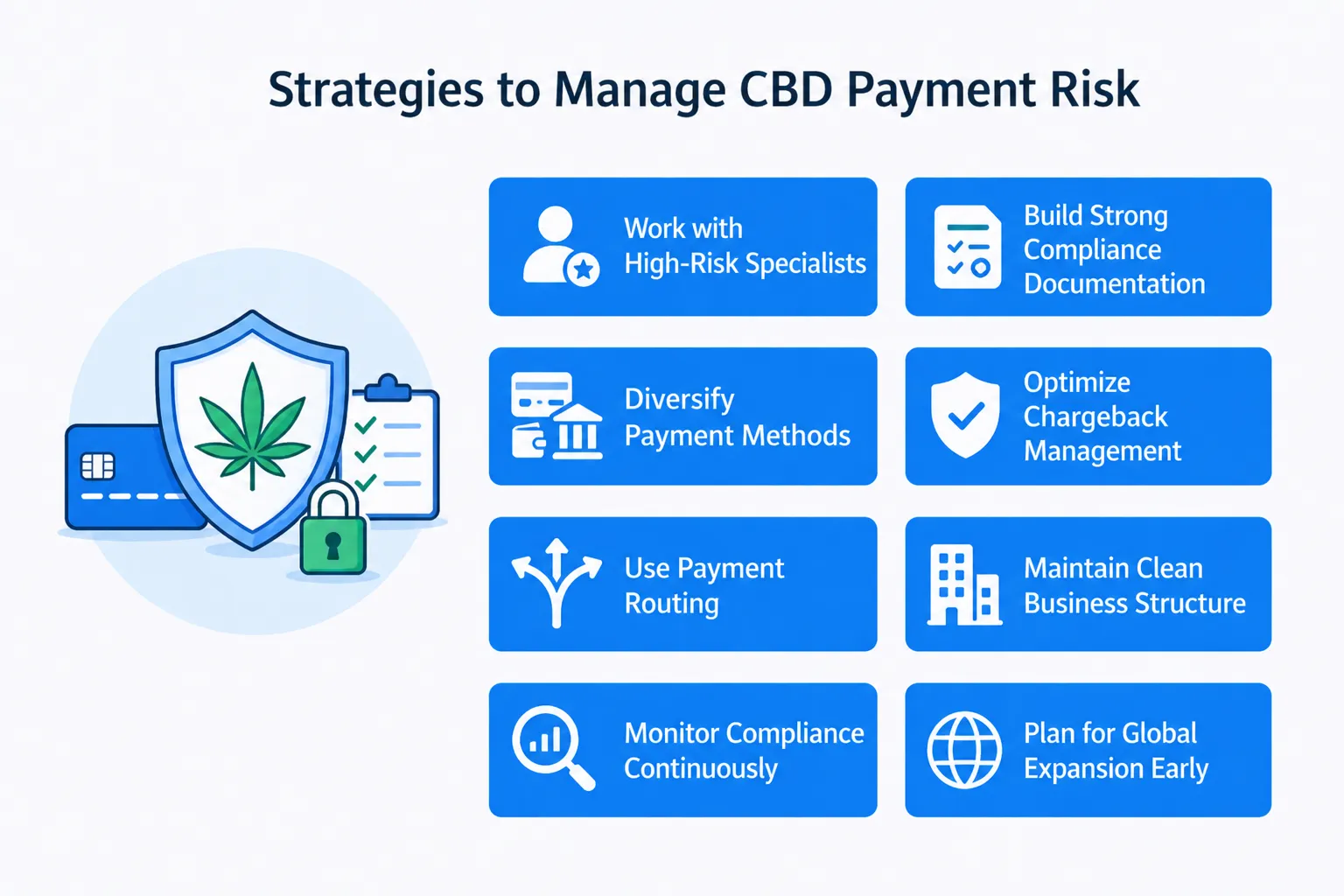
1. Work with High-Risk Specialists
Traditional payment service providers are not designed for CBD. Working with providers that understand regulated and high-risk industries improves approval chances and long-term stability.
2. Build Strong Compliance Documentation
CBD businesses need to maintain clear and updated documentation such as lab reports, THC compliance proof, and accurate product labeling. This helps build trust with payment providers and reduces rejection risks.
3. Diversify Payment Methods
Relying on a single provider increases risk. A mix of card processing, alternative payment methods, and local payment options ensures better acceptance rates and business continuity.
4. Optimize Chargeback Management
Clear refund policies, transparent billing descriptors, and proactive customer communication reduce disputes and help maintain a healthy chargeback ratio.
5. Use Payment Routing
Routing transactions through multiple acquiring banks helps reduce failures and improves approval rates, especially across different regions.
6. Maintain Clean Business Structure
Consistency between your legal entity, website, and payment setup is critical. Any mismatch can trigger compliance flags and lead to rejections.
7. Monitor Compliance Continuously
CBD regulations evolve frequently. Staying updated across regions ensures your payment setup remains compliant and avoids disruptions.
8. Plan for Global Expansion Early
Cross-border payment solutions require region-specific strategies. Planning ahead helps avoid delays, rejections, and compliance issues as you scale.
Payment Flow Optimization for CBD
Beyond approval, optimization plays a major role in scaling CBD businesses.
A strong CBD payment setup includes:
- Multi-acquirer routing
- Smart fraud filters
- Currency optimization
- Geo-based payment routing
Without this, even approved businesses face:
- Higher decline rates
- Poor checkout experience
- Revenue leakage
CBD vs Cannabis Payment Reality
This is one of the biggest misconceptions in the industry.
CBD
- Derived from hemp
- Often legal under THC limits
- Still high-risk for banks
Cannabis (THC)
- Often illegal or restricted
- Heavily regulated
- Mostly excluded from traditional banking
The confusion between these two categories is one of the biggest reasons CBD businesses face payment challenges.
Role of the Right Payment Infrastructure
CBD businesses don’t fail because of demand. They struggle because of the infrastructure.
The right setup can:
- Improve approval rates
- Reduce chargebacks
- Ensure compliance
- Stabilize revenue flow
At FirmEU, we approach global payment infrastructure as a system, not just a gateway. Our focus is on building scalable CBD payment solutions that help businesses operate with greater stability and confidence
This includes:
- Matching business models with the right acquirers
- Structuring compliant payment flows
- Building redundancy into payment systems
Because in CBD, stability is more important than speed.
Conclusion
CBD payment processing shows that legality does not guarantee operational ease. While demand is growing, financial systems still treat CBD cautiously, creating gaps in payment acceptance and scalability. Many businesses focus on product and growth but face issues like high declines, unstable accounts, and slow revenue flow due to weak payment infrastructure.
CBD is not just eCommerce. It is a high-risk category that needs a compliance-first, structured payment setup. Success in high risk CBD payment processing depends on choosing the right partners, diversifying payment methods, and proactively managing CBD Payment Risk.
At FirmEU, we focus on building stable, scalable payment systems so your business can grow without constant disruptions.
Is your CBD business struggling with payment failures or unstable approvals?
If your CBD business is facing payment failures, rising fees, or account instability, it’s not just a provider issue. It’s a setup issue. Work with FirmEU to build a compliant, scalable payment system that actually supports your growth.



FAQs
Is CBD payment processing legal?
Yes, CBD payments are legal in many regions, but they are heavily regulated and still considered high-risk by banks.
Why do payment processors reject CBD businesses?
Main reasons include regulatory uncertainty, chargeback risk, and association with cannabis.
Can CBD businesses accept credit card payments?
Yes, but only through specialized high-risk payment processors that comply with card network and banking regulations.
Why are CBD processing fees higher?
Because providers factor in higher risk, compliance costs, and potential chargebacks. As a result, cbd payment processing fees are often significantly higher than those associated with standard merchant accounts.
How can CBD businesses reduce payment risk?
By improving compliance, diversifying payment methods, and working with specialized providers.
No. FirmEU is not a bank or financial institution. We operate as an independent matchmaking platform, connecting businesses with verified financial partners. All onboarding, KYC, and approval decisions are handled directly by the financial institution.
Still Have Questions?
Our sales team would be more than happy to assist with any futher inquiries



Contact Us

International Payment Solutions
Find the Right Banking and Payment Processing Partner for Your Business
Tell us about your company, and we’ll match you with the most suitable global banking or payment providers from our verified network.
Get Matched