
How to Handle Declined Crypto Transactions With the Right Payment Solution

Garry
July 6, 2026
1
minutes


Crypto payments often feel easy on the surface. A customer selects a wallet, confirms the transaction, and expects it to go through instantly. But when a payment gets declined, the situation becomes unclear.
Unlike traditional payment methods, crypto transactions don’t always give immediate or obvious reasons for failure. This creates confusion not only for customers but also for businesses trying to handle these payments.
The real challenge is not just the decline itself, but how it is handled. In this blog, we will learn how to Handle Declined Crypto Transactions, how payment solutions manage Rejected Crypto Transactions, and what helps businesses reduce such issues over time.
Build a More Reliable Crypto Payment Process
Declined crypto transactions can affect customer experience and business operations. The right payment setup helps reduce failures and supports smoother crypto payments.

Why Crypto Transactions Get Declined
Crypto transaction failures are often misunderstood. They are rarely random and usually occur due to specific gaps in the payment flow or setup. Understanding these crypto payment declined reasons is the first step toward handling them effectively.
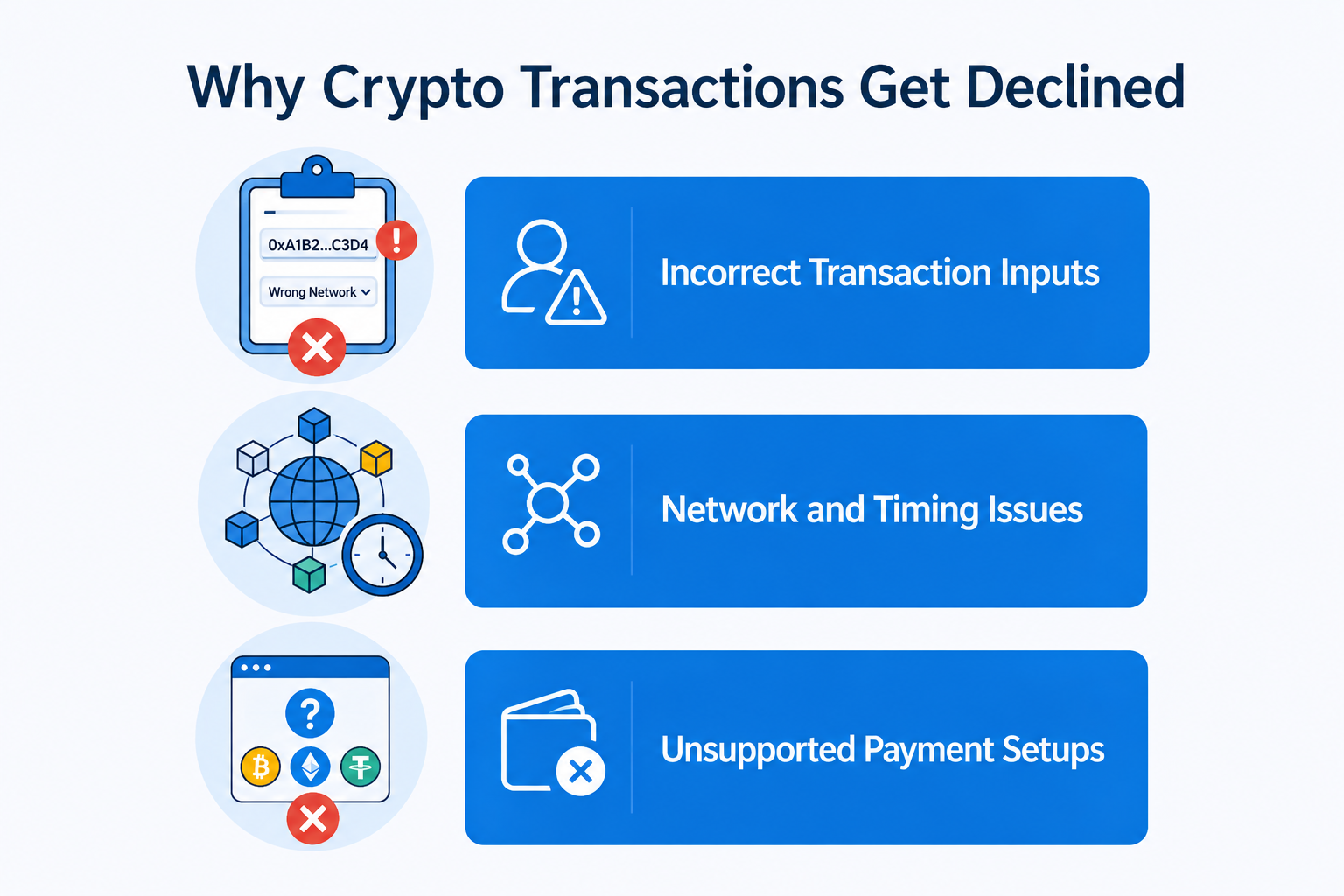
- Incorrect transaction inputs
Incorrect input could be another of the common causes behind declining transactions. Such cases may involve issues like entering an inaccurate wallet address and selecting the wrong network for the transaction.
Such small mistakes could lead to the complete failure of the entire process. It is not always possible to rectify the mistake even after initiating the process, as opposed to other systems.
It thus becomes necessary for the organization to ensure clarity on the part of the user during the transaction.
- Network and Timing Issues
However, cryptocurrency transactions depend on blockchain technologies. There might be lags in these processes from time to time. They might slow down the process of transaction confirmation.
Moreover, if a transaction lasts too long, it will be considered failed because of restrictions that are imposed by the payment system itself. This leads to various scenarios of an unfinished transaction. These kinds of problems occur particularly during times of increased traffic.
- Unsupported payment setups
Not all payment systems are built to handle crypto payments in the same way. Some providers support only particular assets or networks.
When there is a mismatch between what the system assists and what the user selects, the transaction may fail.
This shows the importance of using payment solutions that are properly aligned with the type of crypto payments a business wants to accept.
How Payment Solutions Handle Declines
Managing Rejected Crypto Transactions is not just about identifying failure. It includes a structured process that ensures clarity, control, and the ability to move forward without any confusion.
- Transaction validation checks
During the processing of the transaction, the payment gateway can conduct validation procedures. The validation procedure evaluates factors like the wallet format, the choice of network, and compatibility. This basic task ensures that any errors that might occur in the transaction are discovered early enough to prevent unnecessary problems from arising later. It improves the success rate of transactions and streamlines the entire process.
- Clear failure identification
It is essential when there is any failure in a transaction to know why the transaction has been unsuccessful. There is categorization of transactions by payment solutions depending on their status, which could be either successful, pending, or unfinished.
It becomes easy to diagnose the problems that have occurred without conducting manual research. It ensures that the problem will be easily identifiable.
- User communication flow
One of the most crucial parts of handling declined transactions is communication. Users need to know why their payment did not go through. Payment systems give notifications or messages that explain the issue in a simple and direct way. This reduces frustration and helps users take the correct next step.
Good communication also prevents repeated errors, making the overall payment experience smoother and supporting effective crypto payment troubleshooting.
How Businesses Can Reduce Crypto Declines
While handling declines is crucial, preventing them is even more valuable. Businesses can reduce failed transactions by making a few structured improvements to their payment setup. These improvements also play an important role in Preventing Crypto Transaction Failures before they affect customers.
- Clear payment instructions
Giving clear instructions during the payment process can significantly reduce mistakes. This involves guiding users in choosing the right network and entering the correct details. When instructions are easy and visible, users are less likely to make errors. This leads to a higher success rate for transactions. Clarity at the input stage prevents issues later in the process.
- Controlled payment options
Offering too many options can sometimes create confusion. Instead, businesses can pay attention to supporting only the most relevant and compatible crypto options.
This reduces the chances of users selecting unsupported networks or assets. It also simplifies the overall payment experience. A controlled approach improves both efficiency and reliability.
- Aligned provider selection
Choosing the right payment provider plays a crucial role in reducing declines and Resolving Crypto Payment Issues before they impact business operations. Providers that are designed to handle the crypto transactions can manage these payments even more effectively.
They offer compatibility, smooth processing, and clearer transaction handling. This simply reduces the risk of failures caused by system limitations. Alignment between the business model and the provider ensures a stronger payment setup.
Why Setup Matters More Than Tools
Many businesses try to fix the payment problems by adding more tools or features. However, the real solutions often lie in how the system is structured.
- Structured payment flow
A well-defined payment flow ensures that each step, from initiation to confirmation, is clearly managed. This reduces the chances of breakdowns within the process.
When every stage is aligned, transactions move smoothly without unnecessary interruptions. A structured flow creates consistency in how payments are handled.
- Consistency in transactions
Consistency is crucial for trusted payment operations. When payments are handled in a predictable way, it becomes easy to manage outcomes.
Inconsistent systems can lead to unexpected failures and confusion. With time, this affects both performance and trust. Maintaining consistency helps develop a stable payment environment.
Choosing the Right Payment Partners
Behind every effective payment system is a network of providers and financial partners. Selecting the right ones is crucial for managing crypto transactions successfully.
- Right provider matching
Different providers offer different levels of support for crypto payments. Choosing a provider that fits with your business needs is essential. On the contrary, a mismatch can lead to limited functionality and higher chances of transaction failure. The right provider ensures hassle-free operations and better handling of declined transactions.
- Integrated financial structure
Crypto payments do not exist in isolation. They are part of a broader financial system that includes banking and fund management. An integrated structure makes sure that all the parts of the system work together without gaps. This enhances both efficiency and control. A connected setup reduces friction and supports long-term operations.
Conclusion
Declined crypto payments often reveal something deeper than a simple mistake. They highlight the gaps in how payment systems are designed and connected.
Instead of treating each failure as an isolated issue, businesses benefit more by looking at the overall structure behind their payment flow. When that structure is clear and aligned, declines become easier to manage, making it simpler to Handle Declined Crypto Transactions while reducing future failures.
With the right approach and support for FirmEU, businesses can move from reacting to payment issues to building a system that handles them with clarity and confidence.
Reduce Payment Failures With the Right Banking Network
The right payment partners help reduce transaction failures and improve crypto payment processing. FirmEU connects businesses with trusted banking and payment providers.



FAQs
Is it possible for transactions to be reversed when they are declined?
The majority of declined transactions cannot be reversed since they have not been confirmed yet. However, learning the reasons behind declines will help prevent future mistakes.
Do crypto payments decline more often than other types of transactions?
Yes, they can, because they can be dependent on the network and require correct input. If the system is not constructed properly, such issues may occur more frequently.
Can businesses eliminate crypto payment declines?
Not entirely, since no process can avoid failures entirely. Nonetheless, a system can be developed that would help to minimize such issues considerably.
Does the selection of the provider matter in this process?
It does since providers are responsible for payment compatibility and processing, which are vital for successful transactions.
What can companies do to improve the experience?
Companies can provide customers with better instructions and guidance during transactions.
No. FirmEU is not a bank or financial institution. We operate as an independent matchmaking platform, connecting businesses with verified financial partners. All onboarding, KYC, and approval decisions are handled directly by the financial institution.
Still Have Questions?
Our sales team would be more than happy to assist with any futher inquiries



Contact Us

International Payment Solutions
Find the Right Banking and Payment Processing Partner for Your Business
Tell us about your company, and we’ll match you with the most suitable global banking or payment providers from our verified network.
Get Matched