
IATA Compliance and Travel Banking: What You Need to Know

Garry
July 10, 2026
1
minutes


Running a successful travel company includes more than selling airline tickets or holiday packages. Every booking generates payments, supplier settlements, refunds, and international transactions that require reliable banking support. As the business grows, effective travel agency financial management becomes increasingly important for maintaining stable operations.
For travel agencies, tour operators, and travel management companies, IATA (International Air Transport Association) accreditation often plays a crucial role in building trust within the industry. However, many companies overlook how closely IATA regulations and travel banking are connected. Banking frequently evaluates operational stability, IATA compliance for travel agencies, compliance standards, and transaction profiles before approving travel businesses.
This guide explains how IATA compliance and travel banking work together, what banks evaluate before approving applications, and how to prepare your business for a stronger banking relationship.
Build a Stronger Banking Foundation for Your Travel Business
IATA accreditation is only one part of running a successful travel company. Choosing the right banking partner can make international payments, supplier settlements, and day-to-day financial operations much easier as your business grows.

What Is IATA and Why Does It Matter?
The International Air Transport Association (IATA) is a global organization that supports airlines and establishes operational, financial, and safety standards across the aviation industry. Travel businesses that obtain IATA accreditation demonstrate that they meet the requirements of the well-known industry. This makes them credible when working with airlines and other travel partners.
- Industry Recognition
When a company is accredited by the IATA, it implies that it is operating in accordance with global standards. This strengthens the relationships with airlines, suppliers, and other travel industry stakeholders.
- Credibility in Business
Companies accredited by the IATA usually gain more respect from their clients and business partners. The accreditation is seen as a mark of professionalism and adherence to industry standards.
- Global Opportunities
Many international airlines and travel suppliers prefer to work with companies that are accredited by the IATA. Thus, it can create additional business opportunities while supporting long-term industry growth.
How Travel Banking Differs From Traditional Banking
Travel agency payment management differs from most industries because every booking involves multiple financial transactions across customers, suppliers, and airlines. A single booking may involve payments from customers, settlements with airlines, commissions, supplier invoices, and refunds, often across various countries and currencies. Due to these financial movements, travel companies require banking solutions that can support international operations rather than standard day-to-day commercial banking.
- Travel Payment Flows
While there are other businesses where payment is made in a direct form from the customer to the vendor, payments in the travel business usually consist of more than two parties. An agency can collect payments from the travelers and then transfer them to airlines and hotels, and even earn commission. The result is a constant flow of inflow and outflow of transactions, which requires effective banking arrangements.
- Cross-Border Operations
Travel firms often operate by servicing clients from one nation using suppliers from various other nations. The business transactions would be in a range of currencies and could require international money transfers and settlements. A financial institution familiar with cross-border operations will assist firms in handling such money flows better without slowing down due to currency exchanges and cross-border transactions.
- Industry Risk Profile
The travel industry is usually seen as one that poses some risks to banks because of early booking, cancellation, refunding, seasonality, and volatile transaction volumes. This may affect the way banks evaluate applications and monitor accounts. Banks that are well-versed in the workings of the travel industry are able to handle these operational realities much better than unusual account activities.
The Link Between IATA Compliance and Banking
Obtaining IATA accreditation does more than strengthen your position within the travel industry. It also gives banks and financial partners additional confidence when assessing your business. Although certification doesn’t guarantee banking approval, it demonstrates that your company operates within recognized industry standards, making the evaluation process more simple for many financial institutions.
- Banking Reviews
Whereas the reviews conducted by banks on other businesses are focused mainly on their financial statements. They also assess how the company operates, who its customers are, and whether it follows recognized industry practices. A review of the operations of a travel agency is more comprehensive than that. The mode of operation, the type of clientele served, and adherence to practices in the industry are all taken into account. Strong travel agency IATA compliance helps banks evaluate your business more confidently and often simplifies their review process.
- Payment Partnerships
Travel businesses frequently work with airlines, hotels, tour operators, and global suppliers. These commercial relationships generate complicated payment flows that need dependable banking support, especially when handling payments across multiple countries and suppliers. FirmEU helps travel companies connect with banking partners that understand these operational requirements, making it easier to identify financial institutions suited to companies operating within the travel ecosystem.
- Business Growth
In order for travel firms to enter new destinations and customer bases, their needs when it comes to banking will inevitably become more complex. As their business transactions increase, they should also understand how businesses manage funds in different currencies to simplify international operations. This is where FirmEU comes in by assisting their clients in finding appropriate banks for them.
How Banks Assess Travel Businesses
Banks evaluate more than application forms before deciding whether to onboard a travel company. They review financial performance, operational stability, transaction behavior, and industry regulations to understand how the company manages financial risk. Preparing these areas in advanced can enhance the application process and reduce unnecessary delays.
- Financial Health
The bank is interested in finding out if the company is financially stable enough to function properly. The evaluation includes such aspects as revenue performance, cash reserves, existing debts, and financial standing. Well-kept records will show that the firm is able to fulfill its responsibilities even in slow periods. Well-kept accounting records and good financial reporting also contribute to building confidence during this assessment phase.
- Operational History
Companies with long-standing experience in operation tend to be more trusted by the banks than those that have just started their operation. The banks usually evaluate how long the company has been operating, what kind of market it serves, airline contacts or supplier connections, and general business activity. It is easier for travel firms that have industry credentials such as IATA. We at FirmEU help travel businesses do this job when we introduce them to appropriate banks.
- Transaction Profile
The movement of money in and out of the organization will be reviewed by the bank. This might include the analysis of transaction amounts, payment volumes, refunds, foreign payments, and settlements. The transaction profile that corresponds to the business model of the enterprise will be much easier to assess. Therefore, transparency is a vital step in the process, particularly when choosing a payment provider that fits your business model.
- Compliance Standards
Compliance goes further than just getting an IATA certificate. Banks review internal processes, customer verification procedures, accounting practices, and IATA compliance regulations, along with the regulations that apply to your markets of operation. Having the compliance process structured in a way will demonstrate to financial institutions that you conduct yourself according to recognized standards.
Documents to Prepare Before Applying
A well-prepare application can make the banking review process much smoother. Missing documents, incomplete financial information, or unclear business activities often comes with additional questions and longer onboarding times. Preparing the right information before approaching a banking partner helps present your travel company professionally while allowing the bank to understand your operations more efficiently.
IATA Certificate
If your business holds IATA accreditation, keep the certificate and related documentation readily available. Banks may request proof that your business meets recognized industry standards before moving ahead with the application. Although accreditation alone doen not guarantee approval, it makes your business profile solid and gives additional confidence during the review process.
Financial Records
Recent financial statements, bank statements, and transaction histories will be useful for the bank to assess the performance of your business from a financial perspective. Financial records give an indication of how the business generates income and makes payments. Also, good maintenance of financial records indicates proper accounting in the business.
Business Documents
The usual documents required by the bank include documents certifying the registration of the business, details about the ownership, structure of the company, license, and other legal documents. Preparing these in advance makes it easier when applying for an international business bank account. It is beneficial to submit complete documentation in order to authenticate the business without wasting time. FirmEU cooperates with travel business to determine what documents are asked for by banks.
Transaction History
An accurate representation of transaction amounts, foreign transactions, payments to suppliers, and refunds helps the banks get a clearer picture of your business model. By showing this information clearly, the banks will be able to make their decision regarding your application based on real business transactions rather than any assumptions.
Common Banking Challenges for Travel Businesses
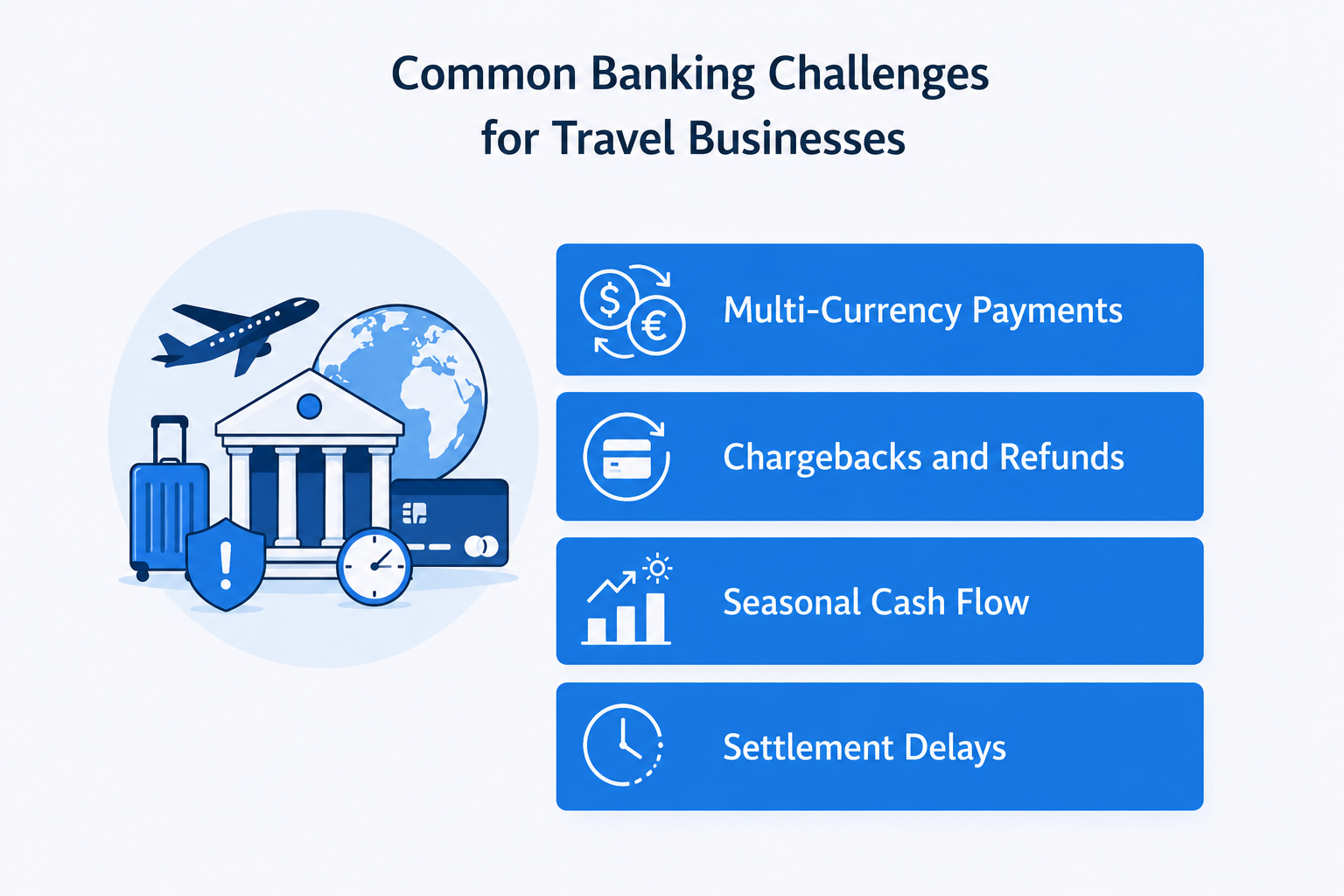
Opening a business bank account is just the first step. Travel companies are continuously dealing with financial issues as operations become increasingly complicated. International booking, cancellations by customers, payments to suppliers, and changes in travel demands have a role in how the flow of money is conducted within the business. Knowing about the problems makes it easier for the company to devise solutions before they start to affect its business operations.
- Multi-Currency Payments
The travel business does not usually use a single currency. The client can pay in Euros, air tickets will be paid in US dollars, and the partner hotels require payments in some other currency. Efficient handling of these transactions requires banking tools that support multiple currencies without unnecessary complexity.
- Chargebacks and Refunds
Booking transactions in the travel industry often have cancellation, change, and refund requirements much more than most other sectors. In case of any unexpected disruption of travel plans, such conditions are likely to result in an increased number of chargebacks. Booking details and refund policies should be accurately recorded to avoid unnecessary loss and gain the trust of the banking community.
- Seasonal Cash Flow
Revenue in the travel business often changes throughout the year. Holiday seasons, school vacations, off and peak seasons, and international events can generate higher booking volumes. While quieter periods may reduce the flow of payments. Planning of these flucutaions helps companies maintain the healthy cash flow and continue meeting operational commitments during slower months.
- Settlement Delays
Payments received from customers don’t always reach travel companies immediately. Airline settlement schedules, supplier payment cycles, and international transfer timelines can affect when funds become available. Working with experienced banking partners and payment providers simply helps improve visibility over settlement timelines. It allows businesses to manage working capital more effectively. FirmEU supports travel companies by connecting them with banking partners that understand these operational realities instead of treating them as unusual financial activity.
How to Find the Right Banking Partner as a Travel Business
Selecting the right banking partner goes beyond creating an account. The partner bank needs to be familiar with the travel industry and its needs, have the ability to provide international service, and still continue to meet your banking needs as your business expands. In selecting your partner, consider the following:
- Select partner banks familiar with the travel industry, airline settlements, refunds, and seasonal transactions.
- Select partner banks with the capability to provide multi-currency accounts and international transactions.
- Make sure that you know what is required in order to create your account.
- Choose a banking partner with the ability to handle expanding transactions internationally.
Instead of approaching multiple banks individually, FirmEU helps travel businesses connect with suitable banking partners based on their operational model and international banking needs, making it easier to find banking support designed for travel companies.
Conclusion
IATA compliance and the right banking partner work together to support a successful travel company. Although industry recognition increases credibility, having the appropriate banking system will assist in managing your payments and settlements and other financial operations more effectively. With proper document preparation, the right understanding of banking requirements, and the assistance of a professional agency such as FirmEU, finding the right financial partner for you will be easier.



FAQs
Does IATA accreditation guarantee banking approval?
Absolutely not. The process of IATA accreditation increases your credibility but does not give you guaranteed approval from banks. Banks analyze your financial history, transactions, compliance and other aspects of your business before providing the answer.
Why is travel banking considered more complex?
Travel companies deal with international payments, payments of refund, settlements with suppliers and work with different currencies. Such finances require special solutions that cannot be offered by standard bank accounts.
What documents do banks usually request?
The list of documents includes business registration documents, financial reports, transaction history, ownership information, and sometimes your IATA accreditation certificate. Documentation requirements might differ depending on a particular bank.
How does FirmEU help travel businesses?
We introduce you to the banking providers who have experience in working with the international travel industry. We act as an intermediary between travel business owners and their future banks.
No. FirmEU is not a bank or financial institution. We operate as an independent matchmaking platform, connecting businesses with verified financial partners. All onboarding, KYC, and approval decisions are handled directly by the financial institution.
Still Have Questions?
Our sales team would be more than happy to assist with any futher inquiries



Contact Us

International Payment Solutions
Find the Right Banking and Payment Processing Partner for Your Business
Tell us about your company, and we’ll match you with the most suitable global banking or payment providers from our verified network.
Get Matched