
Payment Localization Guide for International Businesses

Garry
March 6, 2026
1
minutes
.webp)

Why Payment Localization is Important for Global Businesses?
Like businesses grow beyond their local markets, allowing payments from international customers becomes an important part of operations. Therefore just simply allowing global payments is not always sufficient. Customers from specific countries usually give importance to specific payment ways, currencies, and experiences related to checkout that match their local financial systems.That is where payment localization becomes important.
Payment localization means adapting the payment experience to match the local inclinations of customers in specific regions. Rather than offering a single universal payment option, businesses offer local payment methods, currencies, and checkout flows created for each market.
For example a customer in Europe might like to pay through bank transfers or regional digital wallets, while customers in Asia often depend heavily on mobile payment applications. If a website does not support these similar payment methods, customers are likely to abandon the purchase even if they are interested in the product.
Businesses which follow payment localization usually see improvements in checkout completion, customer trust and international sales performance.
By lining up payment options with regional customer behavior, companies can make their platforms look more accessible to global audiences. In the next section, we will explore what payment localization actually means and how it works in an international commerce. At Firmeu, we help businesses simplify international payments while enabling a localized payment experience tailored to customers in different regions.
Expand Your Global Payment Capabilities
Connect with trusted banks and payment providers that support localized payment methods worldwide.

So what are local payment methods in practice, and how does payment localization tie into it?
Payment localization is adapting a business’s payment system to match the local payment inclinations, currencies, and financial structure of customers in different specific countries. Rather than offering a single global payment option, businesses blend region-specific payment methods that customers already use and trust.
When companies grow internationally, customers expect the checkout process to feel familiar and easy to use . If a website only accepts foreign payment methods or shows prices in another currency, it can create confusion and decrease trust during checkout.
Payment localization solves this by designing and managing the payment experience for each region.
Main Elements of Payment Localization
Most payment localization strategy components include several key elements.
- Pricing of currency on local basis so customers see prices in their own currency
- Regional payment methods such as wallets, bank transfers, or local card networks
- Localized checkout experience that matches regional expectations
Confirmity with local financial regulations
Even when operating globally businesses can make their payment system feel local to customers by following and implementing these elements.
Why Do Global Customers Prefer Local Payment Methods?
Customers are more likely to complete a purchase when they can pay using payment methods
that they already trust and use regularly. When a website only supports unfamiliar payment options or foreign currencies, it can create hesitation during checkout.
Local payment methods are mainly and closely connected to a region’s banking system and consumer behavior. In many countries, people rely on specific digital wallets, bank transfers, or regional card networks instead of using international credit cards.
For example, cross-border payment preferences differ significantly from one region to another.
When businesses support these local payment options, customers feel more comfortable completing transactions because the checkout process resembles what they normally use.
Some key reasons customers prefer local payment methods include:
- Familiar and trusted payment systems
- Clear pricing in their local currency
- Faster payment authorization
- Better compatibility with regional banking systems
- Reduced concern about international transaction fees
By offering localized payment options, businesses can build trust with international customers and reduce checkout abandonment rates.
Key Components of Payment Localization
Successful payment localization involves more than just allowing multiple currencies. Businesses must align their payment infrastructure with regional payment behavior, financial institutions, and checkout expectations to create a smooth experience for international customers.
Several main components help businesses build an effective payment localization strategy.
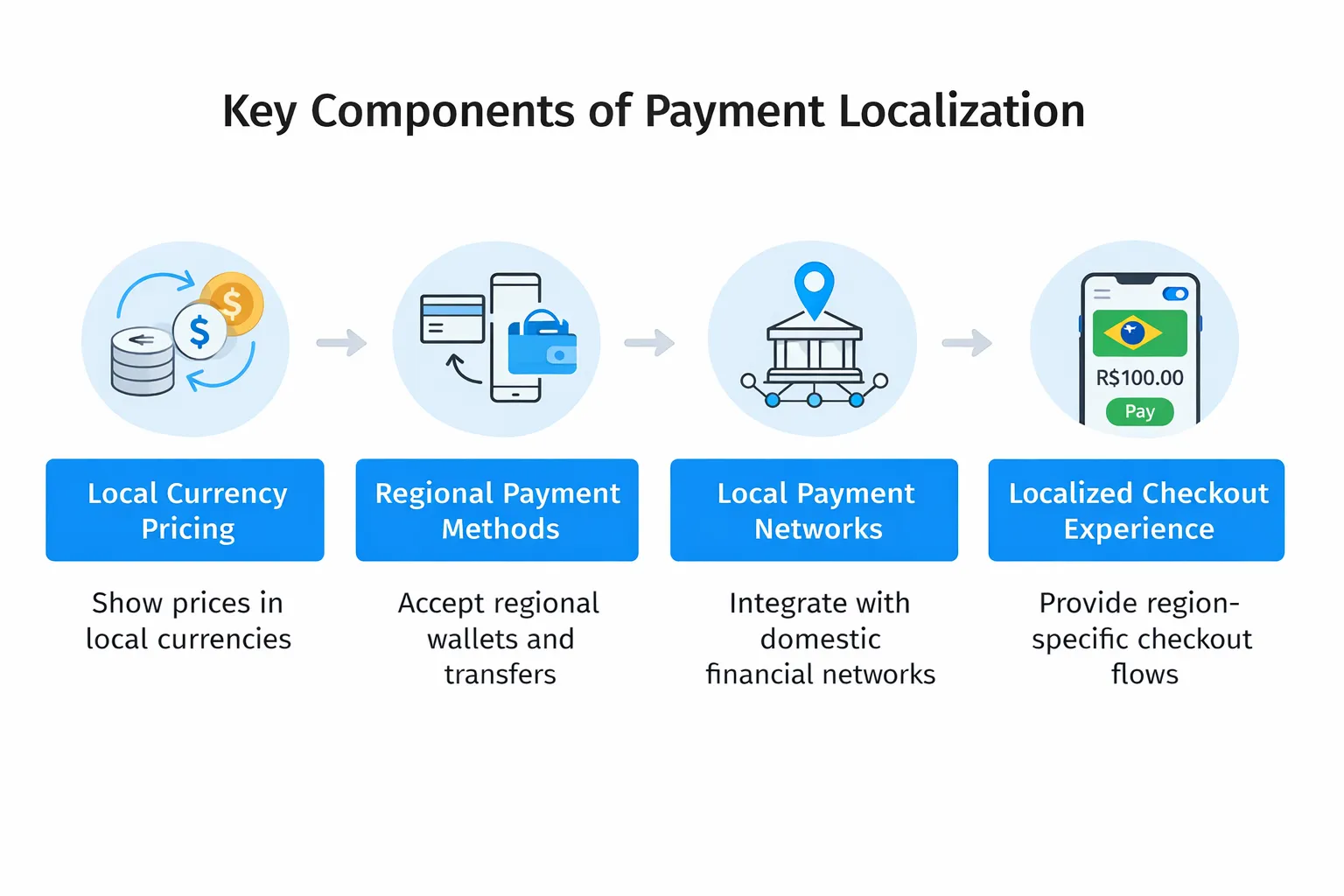
1. Local Currency Pricing
Showing product prices in the customer’s local currency is one of the most important elements of payment localization. It removes the need for customers to calculate exchange rates and helps them clearly in understanding the total cost of a purchase.
2. Regional Payment Methods
Different countries depend on different payment methods. Integrating local payment options allows businesses to match the payment habits of customers in each market.
3. Local Payment Networks
Some regions run their own financial networks that support domestic payments. Integrating with these networks helps make better transaction approval rates and processing speed.
4. Localized Checkout Experience
A localized checkout page might include region-specific payment options, language preferences, and payment instructions that feel familiar to the customer.
By combining these components, businesses can create a payment experience that feels native to each region rather than foreign or complicated.
Popular Local Payment Methods Around the World
Payment inclinations vary widely across different regions. While credit and debit cards remain common in some countries, many markets depend heavily on local payment methods such as digital wallets, bank transfers, or region-specific payment networks.
For businesses choosing and targeting international customers,understanding these regional payment methods by country is essential. Supporting the right payment methods can effectively improve checkout success rates and customer trust.
Below are examples of commonly used local payment methods in different regions.
In many emerging markets, a large portion of customers depend on mobile-based payment systems rather than traditional credit cards. Businesses that only support card payments may miss a significant share of potential buyers.
Some advantages of integrating local payment methods include:
- Higher payment acceptance rates
- Better alignment with regional payment habits
- Faster transaction processing in domestic networks
- Increased trust among local customers
By offering safest payment methods that customers already use in their everyday financial activities, businesses can make their platforms feel more accessible and reliable to global audiences.
How Businesses Implement Payment Localization
Following and implementing payment localization requires businesses to adapt their payment infrastructure to support multiple currencies, regional payment methods, and international transaction flows. Instead of using a single payment setup for every country, companies build payment systems that can handle requirements of different specific regions.
For businesses wondering how to accept local payment methods internationally, the process usually starts with the payment platform itself
The first step usually includes selecting a payment platform or gateway that supports multi-currency transactions and global payment methods. These platforms allow businesses to show prices in local currencies and process payments through regional financial networks.
Businesses also integrate local payment methods that are widely used in their target markets. This may include digital wallets, bank transfers, or regional payment applications.
A typical payment localization process includes:
- Enabling multi-currency pricing for international customers on the website or platform
- Integrating regional payment gateways and local payment methods
- Adapting checkout pages for international users
Ensuring compliance with local financial and payment regulations
By following these steps, businesses can create a payment system that supports global customers while maintaining smooth and reliable transaction processing.
How the Right Payment Infrastructure Helps Global Businesses
A strong payment infrastructure is essential for businesses that operate across multiple countries. As companies grow internationally, they must handle different currencies, payment methods, and regulatory requirements. Without the proper payment setup, global transactions can become complicated and unreliable.
Payment infrastructure connects businesses with banks, payment gateways, acquiring institutions, and financial networks that process transactions from customers around the world. When these systems are properly integrated, businesses can manage international payments more efficiently.
Some of the key benefits of having the right payment infrastructure include:
- Reliable processing of cross-border transactions
- Support for multiple currencies and payment methods
- Better payment approval rates for international customers
- Reduced operational complexity when managing global payments
- Scalable systems that support business growth in new markets
By using the right payment infrastructure in place, businesses can focus on growing their global customer base while maintaining a stable and efficient local payment system for every market they serve
Conclusion
Payment localization plays an important role in helping businesses accept payments from customers around the world. By supporting local currencies, regional payment methods, and localized checkout experiences, companies can reduce payment friction and can make international sales performance better and effective.
Businesses that adapt their payment systems to match regional customer behavior are better positioned to build trust, increase checkout completion rates, and expand into new markets strategically and successfully. At Firmeu, we help businesses simplify cross-border payments by enabling localized payment solutions that make global transactions smoother for both companies and their customers.
Simplify Your Global Payments
Discover payment partners that support local currencies, regional payment methods, and cross-border transactions.


FAQs
How does payment localization improve customer experience?
Payment localization makes checkout easier by showing prices in local currencies, supporting trusted regional payment methods, and providing a familiar payment process for customers.
What role do payment gateways play in payment localization?
Payment gateways help businesses process international transactions, integrate local payment methods, and manage multi-currency payments securely.
What are the benefits of offering local payment options?
Offering local payment options can increase payment approval rates, reduce checkout abandonment, improve customer trust, and support business growth in international markets.
Why is payment localization important for global businesses?
Payment localization helps businesses improve checkout completion rates, build customer trust, and increase international sales by offering familiar payment methods and local currencies.
No. FirmEU is not a bank or financial institution. We operate as an independent matchmaking platform, connecting businesses with verified financial partners. All onboarding, KYC, and approval decisions are handled directly by the financial institution.
Still Have Questions?
Our sales team would be more than happy to assist with any futher inquiries



Contact Us

International Payment Solutions
Find the Right Banking and Payment Processing Partner for Your Business
Tell us about your company, and we’ll match you with the most suitable global banking or payment providers from our verified network.
Get Matched